The Spring Flower Market Made Me Want to Bake: Edible Flowers as a Starting Point
There's a specific kind of restlessness I get in early March.
The snow is still there — not the beautiful December kind, the tired, grey, sidewalk-edge kind — but the florist stalls inside Jean-Talon are doing something interesting, and someone is selling ranunculus in shades of coral I've only seen in Provence cookbooks, next to lilac bundles that have no business being this tempting in a month that still requires a serious coat. And my brain does this thing where it just goes.
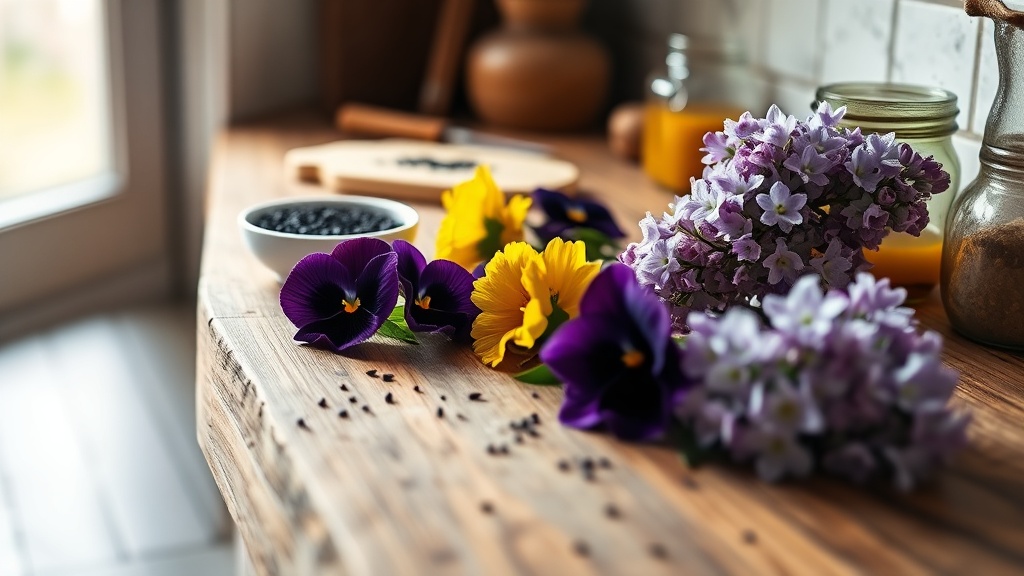
I wasn't shopping for anything specific. I was there for blood oranges, maybe some chèvre if the vendor from Saint-Hyacinthe was back. And then I turned a corner and stopped in front of a bucket of pansies — deep violet, streaked yellow, hothouse-grown and clearly from somewhere warmer than Montréal in March — and the thought arrived fully formed: black sesame. honey. the color of that pansy against a pale financier. yes.
That's how it starts for me. Not "I need a recipe for edible flowers." Not "what pairs with lavender?" It's the sensory hit first — the color, the smell, the particular quality of March light on a velvet petal — and then the cascade. I've been trying to articulate this for a while because people ask how I come up with ideas and I don't have a clean answer. This week I think I finally have a partial one: I go to the market and I look at things.
Why Flowers Fail in Most Baking
Before I get into what I'm actually testing this week, I need to say something a little harsh about edible flowers in baking, because I've eaten enough disappointing lavender shortbread to have opinions.
Most flower baking fails in one of two ways.
The first failure is purely decorative. The candied violet on top of the cupcake that looks beautiful and tastes like absolutely nothing — or worse, like that plastic-y sugar shell that makes you feel vaguely cheated. The flower is there as a costume. It is not doing any work. This is the equivalent of painting a wall an interesting color and then putting a canvas in front of it.
The second failure is the soap problem. Lavender, specifically. Every time I browse a pâtisserie case or a café menu I seem to find it, and too often it tastes like you licked your grandmother's bathroom. This isn't the baker's fault entirely — it's a chemistry problem. Lavender's floral character comes largely from linalool, and linalool at high concentration reads to most palates as soap. The threshold is fussily narrow. A tiny bit: elegant. A normal amount: aggressive. A heavy hand: wrong.
My philosophy when it comes to floral flavor in baking: if the flower is in the recipe, it needs to have an opinion. It needs to actually say something. If I can't taste it without being told it's there, I've used it as decoration and should just put it on top and be honest about that. If it reads as soap or perfume, I've used too much. The goal is somewhere in that narrow band where it tastes like the thing it actually is.
Three Ideas I'm Testing This Week
I came home from the market with a mental list and no actual recipes. That's where I am right now — in the testing stage, which is my favorite stage, where everything is possible and nothing has failed yet.
Lilac shortbread with a brown butter edge
Lilac smells intoxicating and tastes like basically nothing if you're not careful with it. Fresh lilac blossoms are available for about four minutes a year in Montréal (May, traditionally, though apparently I'm getting ambitious). I'm testing with food-grade dried lilac and lilac extract in combination — the dried petals for the visual and textural presence, the extract for the actual flavor delivery.
The brown butter is the structural idea here. Brown butter has its own nuttiness that I think can hold the floral note without letting it drift into perfume territory. The edge of the shortbread is where the butter crisps slightly — that's where I want the contrast to live. Still figuring out whether to do a simple round or a press-in bar. Probably a bar.
Pansy and honey financier with black sesame
This one came directly from that market moment. Pansy petals pressed into the top of a financier, which already has that beautiful amber color — then the black sesame worked into the batter itself for a slight bitterness and nuttiness that I think grounds the honey.
Pansies have a faintly grassy, slightly wintergreen-adjacent flavor — subtle, but real. I'm not trying to amplify the pansy flavor dramatically; I'm more interested in what it does next to the honey and sesame. Sometimes a flavor combination is about contrast and coexistence, not about each ingredient screaming.
The financier format is ideal for this because it's a small, elegant thing. The visual is already there: dark sesame flecks in the batter, honey glaze, one perfect pansy pressed in before baking so it melds instead of sitting on top like an afterthought.
Elderflower and lemon panna cotta
Okay, this one is the classic-for-a-reason situation and I am not above it.
Elderflower works in a way that most other floral flavors don't, and I think it's because the flavor is more fruity-musky than straight floral. St-Germain exists because of this. Elderflower and citrus — specifically lemon, and specifically lemon zest rather than juice — is a combination that has been working for decades and I'm not going to be contrarian about it.
What I want to test is the texture relationship. Panna cotta sets with a specific kind of softness that I think is actually the ideal vehicle for elderflower — it's delicate enough not to overpower it, cold in a way that preserves the floral quality, and the wobble is frankly a sensory experience that I love in a way that is probably disproportionate to how normal that is.
I'm thinking elderflower cordial worked into the cream, a thin layer of lemon gel on top, and something crunchy underneath — maybe a simple almond tuile base. The acid from the lemon cuts any sweetness that might tip into cloying.
The Technical Question I Haven't Answered Yet
Here's where I'm actually stuck, in the best way: fresh petals vs. dried petals vs. extract, and when does each make sense?
My working hypothesis:
Fresh petals — primarily visual and textural, sometimes a faint flavor contribution. Best pressed into the surface of something where you want the actual flower to be present and seen. Pansies baked into financiers. Rose petals on cream. The flavor isn't the point; the presence is.
Dried petals — more concentrated flavor, but also more unpredictable. Lavender dried is much more potent than fresh. The texture when baked in can be papery and strange if you're not careful. Better for steeping into cream or butter and then straining out.
Extract — the most consistent flavor delivery, the least visual interest. Good when you want the flavor without the textural or visual element of the flower. Also the easiest to oversaturate with, which is how you get soap shortbread.
I think the lilac shortbread might end up using all three — dried petals steeped in butter for flavor, extract for presence, fresh pressed on top for the visual. We'll see. I'll report back when I have something that actually works.
Spring in Montréal is a whole negotiation. You get the hothouse flowers before you get warm weather. You get the idea of spring before you get spring itself. And weirdly, I think that's a better creative state — anticipation before arrival, wanting before having. The walk through Jean-Talon on a cold March morning with pansy petals in my head and nothing decided yet is maybe my favorite place to be. It's the same place I start with any seasonal ingredient — waiting for something to click.
Now I just have to figure out the lilac.