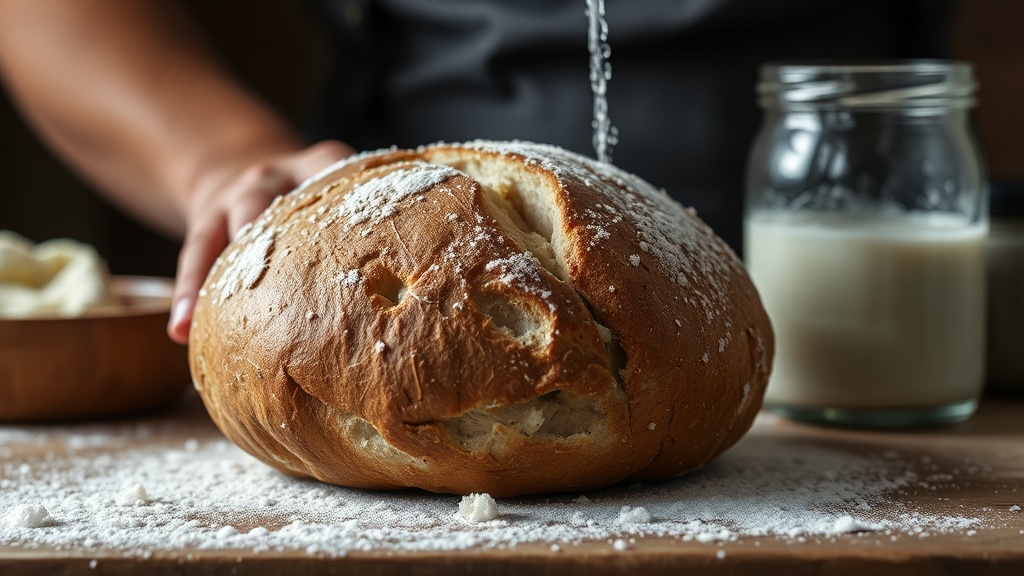
The Golden Ratio: Perfecting Your Sourdough Hydration

Quick Tip
Higher hydration creates more open crumb, but requires stronger flour and more frequent folds.
The sunlight hits a marble countertop at just the right angle, revealing the translucent, elastic sheen of a high-hydration dough. It looks less like food and more like a piece of blown glass—supple, shimmering, and full of potential. This is the moment where chemistry meets artistry, and understanding the ratio of water to flour determines whether your loaf will be a structural masterpiece or a collapsed puddle.
Understanding the Hydration Scale
Hydration is not a vague concept; it is a precise mathematical ratio. In the professional baking world, we calculate this by dividing the total weight of the water by the total weight of the flour. For example, if you are using 500g of King Arthur Bread Flour and 350g of water, your hydration is 70%.
Finding your "sweet spot" depends heavily on your flour's protein content and your environment. In a humid Montréal summer, your dough will feel much wetter than it does during a dry January. Keep these benchmarks in mind:
- 65% - 70% Hydration: Ideal for beginners. The dough is manageable, holds its shape easily during scoring, and is less prone to sticking to your Danish Dough Whisk or hands.
- 75% - 80% Hydration: The "sweet spot" for open crumb structures. This requires advanced handling techniques like coil folds to build strength.
- 85%+ Hydration: Advanced territory. This produces an incredibly airy, custardy interior but requires high-protein flour (at least 13-14% protein) to prevent the dough from losing its structural integrity.
Techniques for High-Hydration Success
If you want to push toward a higher percentage without the frustration of a sticky mess, focus on autolyse. By mixing only your flour and water and letting them rest for 30 to 60 minutes before adding salt and starter, you allow the gluten to begin developing naturally. This makes the dough significantly more extensible.
When working with high-hydration doughs, avoid aggressive kneading. Instead, use the stretch and fold method every 30 minutes during the bulk fermentation stage. This builds strength incrementally, allowing the water to be fully integrated without breaking the delicate air bubbles being created by your wild yeast.
"Treat your dough like a sculpture. If it is too soft to hold a shape, you haven't built enough tension; if it is too stiff, you have restricted its ability to expand."
Mastering this ratio allows you to treat your sourdough as a true medium, capable of producing everything from tight, sandwich-style loaves to wildly aerated, artisan boules.