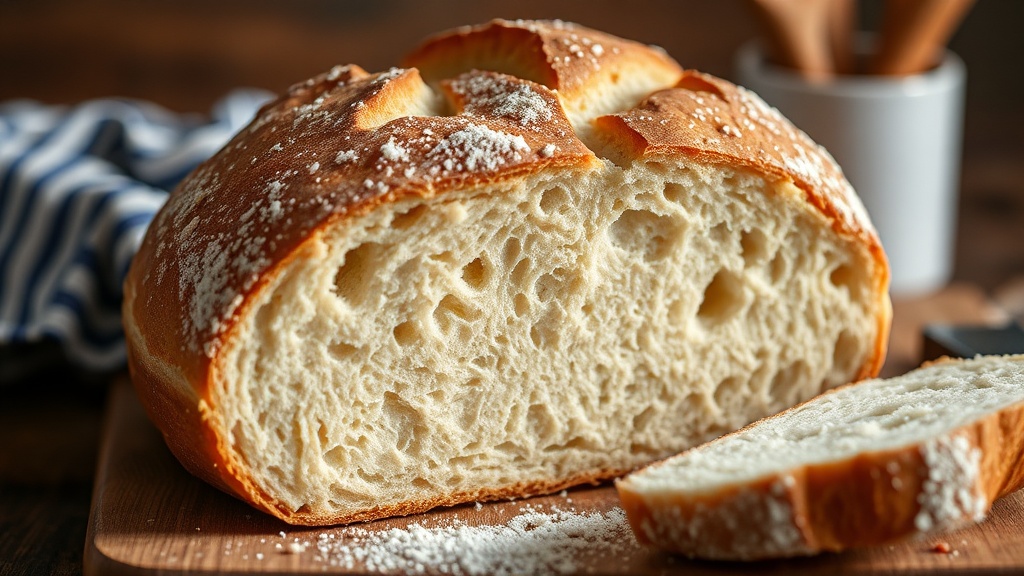
The Complete Beginner's Guide to Perfect Sourdough Bread

This guide walks through every step of baking your first sourdough loaf — from building a starter to pulling a golden, crackling crust from the oven. Sourdough isn't just bread; it's a skill that rewards patience with loaves that supermarket bakeries simply can't touch. You'll learn the timing, the techniques, and the small details that separate dense disappointment from airy triumph.
What Equipment Do You Need to Start Baking Sourdough?
You don't need much — but what you do need matters. The right tools make the process smoother and the results more consistent.
Here's the thing: sourdough baking happens in stages, and each stage has its own requirements. A digital kitchen scale (the OXO Good Grips 11-Pound Scale works beautifully) eliminates guesswork. Volume measurements fail here — flour compacts, humidity varies, and sourdough demands precision.
You'll want a large mixing bowl (glass or ceramic, not metal — acids react), a bench scraper for handling sticky dough, and a Dutch oven. That last item isn't negotiable. The Lodge 6-Quart Enameled Cast Iron Dutch Oven traps steam during the initial bake, creating the oven spring and crust texture that defines great sourdough. It runs about $90 — less than ten mediocre bakery loaves.
| Item | Purpose | Budget Option | Upgrade Pick |
|---|---|---|---|
| Digital scale | Precise measurements | AWS SE-50 ($15) | OXO Good Grips ($56) |
| Mixing bowl | Combining ingredients | Pyrex 4-quart ($12) | Emile Henry ($65) |
| Dutch oven | Trapping steam for crust | Lodge 6-qt ($90) | Le Creuset 5.5-qt ($390) |
| Banneton | Shaping and proofing | Round basket ($15) | Breadsmart oval set ($40) |
| Lame | Scoring dough | Wooden handle ($10) | WireMonkey ARC ($28) |
A banneton (proofing basket) helps your loaf hold its shape during the final rise. The woven material wicks moisture from the surface, creating that distinctive flour-dusted pattern. Don't skip this — a bowl lined with a floured tea towel works in emergencies, but the results suffer.
How Do You Build a Sourdough Starter From Scratch?
Mix equal weights of flour and water, wait, discard half, feed again — repeat for about seven days until the mixture doubles predictably within 4-6 hours.
Start with 50 grams whole wheat flour and 50 grams water (room temperature, not cold from the tap). Whole wheat contains more wild yeast and bacteria than white flour, so it colonizes faster. Stir until smooth, cover loosely, and leave it somewhere warm — 70-75°F is ideal. The top of a refrigerator works. So does an oven with the light on.
After 24 hours, discard all but 50 grams of the mixture. Add 50 grams flour (now switch to all-purpose or bread flour) and 50 grams water. Stir. Wait. The catch? You must do this every day, roughly the same time, for a week. The starter will look dead for the first three days — no bubbles, no rise, just sad flour soup. This is normal. The bad bacteria arrive first; the good yeast takes longer to establish dominance.
By day five or six, you should see doubling within 4-8 hours of feeding. The starter will smell tangy — like yogurt or vinegar — and fall back down after peaking. That's when you know it's alive. Worth noting: if mold appears (fuzzy colors, not just a dark liquid on top), toss it and start over. A dark liquid layer (hooch) just means it's hungry — pour it off or stir it in, then feed.
Once your starter doubles reliably, you can slow down. Keep it in the refrigerator and feed it weekly, or maintain it at room temperature for daily baking. The King Arthur Baking sourdough guide offers excellent troubleshooting if your starter stalls.
What Is the Best Flour for Sourdough Bread?
Bread flour with 11-13% protein content produces the best structure, though many bakers blend in whole wheat or rye for flavor complexity.
Protein matters because it becomes gluten — the network that traps gas and creates those open, irregular holes sourdough is famous for. All-purpose flour (10-11% protein) works, but the loaf spreads more and rises less. Bread flour (the King Arthur Unbleached Bread Flour at 12.7% protein is widely available) gives you more strength and height.
That said, 100% white flour makes boring bread. Most bakers use a blend: 80% bread flour, 20% whole grain (wheat, rye, or spelt). The whole grain ferments faster — those wild yeast nutrients again — and adds nutty, earthy depth. Montréal's own Farine Five Roses all-purpose flour has a cult following among Quebec bakers for its consistent performance in sourdough, though it behaves more like American bread flour than typical all-purpose.
Don't use bleached flour. The bleaching process damages the proteins and destroys the carotenoid pigments that give sourdough its golden color. Unbleached, unbromated is the way — brands like King Arthur, Bob's Red Mill, or local mill flours from Breadtopia's organic selection.
Water and Salt: The Quiet Heroes
Tap water is usually fine — unless your municipality loads it with chlorine, which can suppress fermentation. If your starter struggles, leave a jug of tap water out overnight (the chlorine evaporates) or use filtered water.
Salt controls fermentation speed and strengthens gluten. Use fine sea salt or kosher salt — not iodized table salt, which can impart metallic flavors. The standard ratio is 2% of the flour weight: for 500 grams flour, use 10 grams salt. You'll mix this in after the initial rest (autolyse), never directly into the starter — salt slows yeast activity.
How Long Does Sourdough Bread Take to Make?
From mixing to slicing: about 24 hours, though only 30 minutes require your actual attention.
The timeline breaks into stages: autolyse (30-60 minutes), mixing and bulk fermentation (3-5 hours), shaping and bench rest (30 minutes), final proofing (3-12 hours depending on temperature), and baking (45 minutes). Most of this is waiting — the dough does the work.
Here's a realistic weekend schedule: mix your dough Saturday evening, let it bulk ferment overnight in a cool kitchen (65-68°F). Sunday morning, shape it, proof for 2-3 hours, then bake. The long, cold fermentation develops deeper flavor — those tangy, complex notes that make sourdough distinctive.
Warm kitchens (75°F+) speed everything up — sometimes too much. The dough can overproof, turning slack and sour with poor oven spring. In summer, use cold water for mixing and proof in the coolest spot available. In winter, warm water helps. Sourdough is alive; it responds to its environment.
The Stretch and Fold Technique
Kneading sourdough is outdated. Modern bakers use stretch and folds — gentler, more effective, and easier on the wrists.
After mixing your dough (flour, water, starter, and salt), let it rest 30 minutes. Then wet your hand, grab one side of the dough, stretch it up, and fold it over the center. Rotate the bowl 90 degrees. Repeat three more times. That's one set. Do this every 30 minutes for the first 2 hours of bulk fermentation — four sets total.
The dough transforms. It starts shaggy and sticky; by the fourth set, it's smooth, elastic, and holding together. Each fold builds gluten structure without the aggressive tearing of traditional kneading. You'll feel the difference — the dough gains body and resistance.
Scoring and Baking
Score decisively. A shallow cut heals over; a deep, confident slash opens beautifully.
Transfer your proofed dough onto parchment paper. Hold your lame (or a razor blade) at a 45-degree angle, not straight down. Cut 1/2 inch deep in one smooth motion — a curved line from ear to ear works well, or a single straight slash for an "ear" (that raised ridge of crust). The score controls expansion; without it, the loaf bursts randomly.
Preheat your Dutch oven at 450°F for at least 45 minutes — it needs to be scorching. Drop the dough in on its parchment, cover, and bake 20 minutes. Remove the lid (carefully — steam burns), then bake 20-25 minutes more until the crust is deep mahogany and the internal temperature hits 208-210°F. Cool completely on a wire rack — at least an hour. Cutting warm sourdough gums up the crumb.
The best loaves come from bakers who pay attention. Notice how the dough feels, how it smells, how it responds to touch. Sourdough isn't a recipe to follow blindly — it's a relationship to develop. Your sixth loaf will surpass your first. Your twentieth will make you proud.